


For years, international education has largely revolved around four major destinations: the UK, Canada, Australia, and the USA. These countries have long dominated student preferences due to their strong university rankings, post-study work opportunities, and global recognition.
However, 2026 is showing a noticeable shift.
Across the international education industry, students are increasingly exploring alternative destinations that offer affordability, visa stability, quality education, and realistic long-term opportunities. As global visa policies tighten and living costs continue to rise, emerging destinations are no longer considered “backup options”. They are becoming strategic first choices.
At GEP - Global Education Platform, we are seeing a growing number of students actively researching countries beyond the traditional Big 4, especially those looking for a balanced combination of education quality, career opportunities, and financial sustainability.
Why Students Are Looking Beyond Traditional Destinations
The shift is being driven by several global trends that are reshaping student priorities.
1. Visa Uncertainty and Policy Changes
Recent visa restrictions, longer processing times, and tighter immigration pathways in some traditional destinations have created uncertainty among students and parents. Many are now prioritising countries with clearer and more stable visa systems.
Students today are making decisions based not only on university rankings, but also on:
- Visa approval likelihood
- Dependable post-study pathways
- Immigration transparency
- Lower financial risk
This has opened the door for emerging destinations to gain attention.
The Rise of Emerging Study Destinations
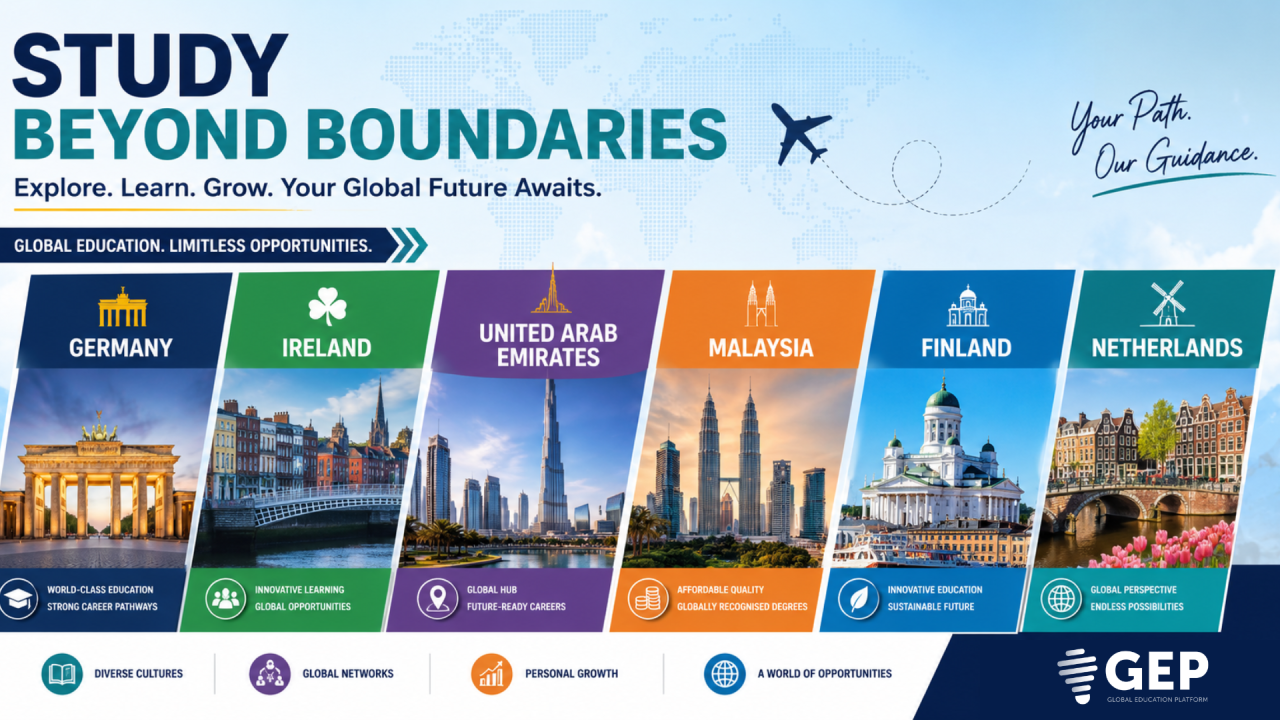
Germany
Germany continues to attract international students due to its affordable tuition structures, strong engineering and technology programmes, and growing demand for skilled graduates.
Public universities offering low-cost education, combined with Europe-wide career exposure, have made Germany highly attractive for students seeking value-driven education.
Ireland
Ireland has rapidly strengthened its position as a preferred English-speaking destination. With a growing technology sector and the presence of multinational companies, students are seeing strong career potential after graduation.
Its welcoming environment and expanding post-study opportunities continue to attract students from South Asia and beyond.
United Arab Emirates
The UAE is becoming increasingly popular among students looking for modern campuses, global branch universities, and proximity to home countries.
Cities such as Dubai are positioning themselves as international education hubs, offering globally recognised degrees with lower relocation stress and strong regional employment opportunities.
Malaysia
Malaysia is gaining popularity due to its affordability and partnerships with international universities. Students can often complete globally recognised qualifications at a significantly lower overall cost compared to traditional destinations.
For families carefully managing budgets, this has become a major advantage.
Finland and Netherlands
Both countries are seeing rising interest due to their innovative education systems, sustainability-focused learning environments, and growing number of English-taught programmes.
Students increasingly appreciate the emphasis on practical learning, research, and work-life balance.
Students Are Becoming More Strategic
One of the biggest changes in 2026 is the mindset of students themselves.
Previously, many students selected destinations primarily based on popularity or social influence. Today’s students are far more research-oriented and outcome-focused.
They are asking questions such as:
- What is the return on investment?
- Can I realistically secure part-time work?
- Is the visa pathway stable?
- What are the long-term career opportunities?
- Can I manage the living expenses comfortably?
This shift is pushing education agents and institutions to provide deeper guidance rather than simply promoting well-known destinations.
The Role of Education Agents Is Also Evolving
The modern international education consultant is no longer just an application processor.
Students now expect strategic guidance, destination comparisons, financial planning advice, and accurate visa-related support. Agents who understand global policy changes and emerging opportunities will be far better positioned in the coming years.
At GEP - Global Education Platform, we believe the future of international education will be driven by adaptability, diversification, and informed decision-making.
Final Thoughts
The global education landscape is evolving rapidly.
While the traditional Big 4 destinations will continue to remain important, emerging destinations are proving that quality education, career growth, and international exposure are no longer limited to a few countries.
In 2026, students are choosing stability, affordability, flexibility, and long-term opportunity over popularity alone.
And this may only be the beginning of a much larger transformation in international education.


